
The Oldest Gem
How an oyster's worst day became the world’s most mythologized object — and how one video game remembered what everyone else forgot

I spent an afternoon last week opening drawers.
That’s not unusual for me — the Natural History Museum of Los Angeles County contains millions of specimens, and a substantial portion of my job involves knowing what’s in which drawer. But this particular afternoon I was looking at pearls, and the longer I looked, the more I realized I was holding exactly the right kind of object for a museum drawer. A museum is a diary of everything that has ever happened. And a pearl, it turns out, is a diary too — written in aragonite, layer by layer, by an animal that had no idea it was writing.
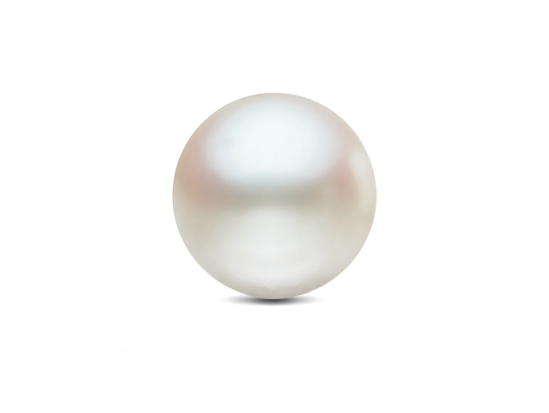
A pearl is not supposed to be here. It was made in the dark, inside a living animal, in a moment of biological emergency. It wasn’t carved or cut or synthesized. It was secreted — layer by microscopic layer — by a creature that had no idea it was making something beautiful. And now it’s in a climate-controlled drawer in Los Angeles, catalogued and lit, waiting for someone to wonder about it.
I started wondering about what happens to an object like this when it leaves the drawer. Not just the specimen — the idea of it. The pearl has been circulating through human culture for at least four thousand years: worn by Roman emperors, traded across the Persian Gulf, painted into Renaissance portraits, named into languages. Every culture that encountered it had to decide what it meant. Most of them decided it meant wealth, or beauty, or the sea, or all three at once.
What I wasn’t expecting was to find the most faithful answer in a video game. In Immortals Fenyx Rising, you roll a pearl across a hillside and a goddess is born from the sea — which is exactly what Greek mythology says should happen. Aphrodite rises from sea foam. The water droplets from her hair transformed into pearls. A pearl, born in saltwater, returned to the ocean. Of course that’s right. The question it left me with wasn’t why, but whether any other game had noticed. So I went to the database.
I found nineteen games with pearl. Almost all of them had turned it into a trade commodity worth a few in-game gold pieces.
What a Pearl Actually Is
Let’s start with the biology, because the biology is the story.
A pearl begins with an intrusion. Something enters the soft tissue of a mollusk — a parasite, a fragment of shell, occasionally a grain of sand, though that romantic image is rarer than people believe. The animal cannot remove it. What it can do is wall it off, coating the intruder in the same material it uses to line its shell: nacre. Aragonite — calcium carbonate crystallized in the orthorhombic system — laid down in overlapping hexagonal platelets, each nanometers thick, bound together by a protein called conchiolin. The iridescence you see isn’t pigment. It’s physics: light diffracting between those stacked platelets, the interference pattern changing as you tilt the pearl in your hand.
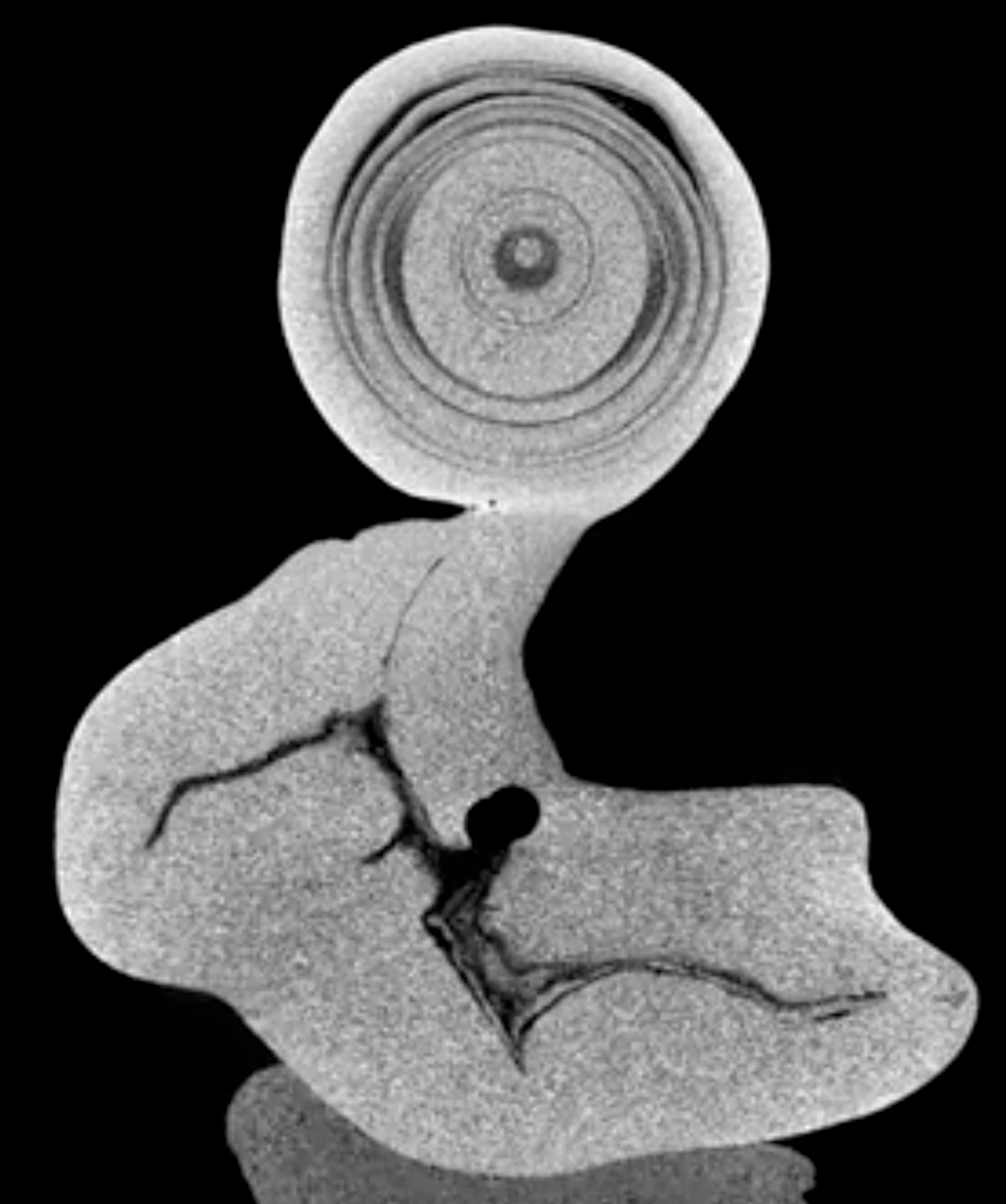
The animal keeps going. Month after month, year after year, it adds layers. A large pearl might represent a decade of continuous biological labor. Every layer records something: the temperature of the water that season, the chemistry of what the animal was eating, the isotopic signature of the rainfall upstream. A pearl is, among other things, a diary.
And here’s something most people don’t know: oysters don’t have a monopoly on this. Freshwater mussels make them. Abalone make them. Conch make them — conch pearls are a pale flamingo-pink, non-nacreous, and among the rarest gemstones on Earth. Giant clams make them, though the result tends toward porcelain-white rather than iridescent. Nautiluses have been known to produce them. Even some gastropods manage it. The biological impulse to wall off an irritant with crystallized carbonate is ancient and widespread. Almost any shelled mollusk, given the right (which is to say, wrong) circumstances, will try.
What differs between species is the quality of the nacre. The finest nacreous pearls — the ones human beings have fought wars over, crashed markets for, built empires around — come primarily from Pinctada species in marine environments and from Margaritifera margaritifera, the freshwater pearl mussel, in cold, clean rivers across the Northern Hemisphere. The freshwater pearl mussel can live over a century. A single individual might produce pearls across a human lifetime. They are also, due to water pollution and habitat loss, critically endangered across most of their range.


The Pearl as Environmental Archive
Here is where it gets interesting for a mineralogist.
Each growth layer in a pearl's nacre records the isotopic and chemical conditions at the time of its deposition. Oxygen isotope ratios (δ¹⁸O) in aragonite shift predictably with water temperature — cold water incorporates more ¹⁸O, warm water less. In principle this makes nacre an environmental archive: a record of the water the animal lived in, written in crystal. In practice, reading that record in a pearl is harder than it sounds. Unlike the shell of the mussel itself — where growth increments are well-structured and have been used to reconstruct river temperatures going back centuries — pearl layers don't form on a reliable schedule. They aren't annual rings. The archive is real, but the calendar is ambiguous. What a pearl records is the character of its environment: the chemistry, the temperature range, the isotopic fingerprint of the water. Not a timestamp. A portrait."
Freshwater pearl mussels are particularly valuable here. M. margaritifera is long-lived, geographically widespread, and builds its shell in isotopic equilibrium with river water. Its oxygen record has been used to reconstruct historical river temperatures and seasonal hydrology going back centuries in river systems across Europe and North America. The annual growth increments are legible. The chemical diary is readable.
But the pearl’s value as an archive doesn’t stop at the Holocene. Fossil pearls exist — and they are extraordinary.
The oldest known fossil pearls date to roughly 230 million years ago, from Triassic marine deposits. Mollusks have almost certainly been producing pearls since they first evolved shells, over 500 million years ago, meaning the fossil record of pearls is limited mainly by preservation, not by biology. During fossilization, the aragonite that makes up nacre is typically replaced by calcite — but crucially, the concentric layered structure is preserved. A cross-section of a 200-million-year-old fossil pearl still shows you the growth rings. Occasionally, where burial conditions were favorable, original aragonite survives with its nacreous luster intact.
Florida, which was submerged beneath warm shallow seas for most of its geological history, is a notable repository. The Florida Museum of Natural History holds fossil pearls from Plio-Pleistocene marine deposits, 5 to 23 million years old, some still sealed inside fossilized clam shells as blister pearls — exactly where the animal left them. Devonian deposits in Germany have yielded pearl-like structures from ammonoid hosts. Cretaceous deposits in California and Kansas have produced fossil pearls recorded in the geological literature as far back as the 1920s.
There is also a genuinely strange footnote from Sarasota County, Florida, where researchers sifting through fossilized quahog clams found 83 tiny glass spheres — perfect, pearl-sized, translucent — preserved inside 2-to-3-million-year-old shells. After a decade of uncertainty, the leading interpretation is that they are microtektites: glass beads formed when a meteorite impact sent molten material into the atmosphere, which then rained down into the sea and was captured by living clams before they fossilized. Meteorite debris, preserved inside a pearl-making animal, turned to stone over millions of years. The clam didn’t know it was making a time capsule. It was just doing what clams do.
A History Worth More Than Gold
For most of human history, the pearl was the precious gem. Not diamonds. Not rubies. Pearls.
The oldest known worked pearl jewelry dates to around 420 BCE, found in a sarcophagus at Susa in what is now Iran. But pearl diving in the Persian Gulf and the Gulf of Mannar is substantially older — evidence suggests a prehistoric origin, with diving operations established thousands of years before recorded history. Pliny the Elder, writing in the first century CE, called the Persian Gulf fishery the most productive in the world. He was not wrong.
For centuries, the pearl trade ran through a specific geography: divers in the Persian Gulf and off the coast of Sri Lanka descending without equipment — no tanks, no wetsuits — to depths of 30 meters or more, holding their breath, prying oysters from the seabed. The harvest was sorted, size-graded, and shipped to brokers in India, then to markets in Western Europe. Paris was the center of the wholesale trade. The rarest, most perfect specimens fetched prices equivalent to the cost of entire warships.
The Gulf pearl diving economy supported coastal communities across what is now Bahrain, Qatar, the UAE, and Kuwait for millennia. At its peak in the early twentieth century, tens of thousands of divers participated in the annual season. The work was brutal and frequently deadly — decompression sickness, shark encounters, drowning. The debt systems that organized the industry often amounted to indentured servitude across generations. The pearl was beautiful. The industry that produced it was not.
And then, in the early twentieth century, a Japanese entrepreneur named Mikimoto Kōkichi figured out how to do it reliably at scale. Cultured pearls — pearls grown in farmed oysters around a deliberately inserted nucleus — had been attempted before, but Mikimoto systematized the technique, achieved consistent quality, and brought pearls to a price point that the middle class could access. The natural pearl market collapsed almost overnight. Fortunes built across centuries of Gulf diving evaporated in a decade. The discovery of oil finished what Mikimoto started: the dive economy was already dead by the time there was something more profitable to extract from beneath the same water.
The cultural weight of all this — the mythological associations, the diving economies, the market collapse, the transition to cultivation — is immense. And almost none of it survives into the medium that now commands more hours of human attention than any other.
What Games Do With It
I searched my database of 292 games. Nineteen of them include pearl as a meaningful material.
Here is what pearl does in those nineteen games: it crafts things, augments power, trades for currency, and occasionally signals that a game has maritime content. In Civilization, it’s a coastal luxury resource that boosts happiness. In the Atelier series, it’s a crafting ingredient with vaguely oceanic flavor. In Final Fantasy XIV, it’s a trade good you gather from the sea. In Diablo, it’s a gem you socket into equipment for a defense bonus. In Risk of Rain, the Irradiant Pearl is a rare item that boosts all your stats — a shiny thing that makes numbers bigger.
This is what I’d call the flattening. The pearl arrives in games already stripped of its biography. It has no animal, no irritant, no years of deposition, no isotopic record. It has no diving economy, no Mikimoto, no market collapse. It has no Aphrodite. It is a colored token with a stat attached, and its color is the same iridescent white it has always been, because that at least the art department noticed.
There is one partial exception I want to note before getting to the main one. The Legend of Zelda: The Wind Waker (2002) builds its entire first act around collecting three Goddess Pearls — Nayru’s Pearl, Din’s Pearl, Farore’s Pearl — which you gather from divine beings scattered across a flooded world and use to raise ancient temples from beneath the sea. The pearls are sacred objects, gifts from goddesses, keys to a drowned geography. They do not craft anything. They are not currency. They exist to enact the myth of a world that sank beneath the waves. It’s the right instinct, and it’s the right material for it: pearls belong to the ocean in a way that diamonds and rubies fundamentally do not.
But Wind Waker’s pearls are still somewhat abstract — divine MacGuffins with evocative names. What happened in 2020 is different.
The One That Remembered
Immortals Fenyx Rising is a game that gets less credit than it deserves for its mythological literacy. It is, on the surface, an open-world action game in the Breath of the Wild mold, set in a colorful version of ancient Greece. But the writing — delivered largely through a framing device in which Prometheus narrates the story to Zeus with considerable irreverence — is genuinely attentive to its source material in ways that most “mythology games” are not.
The Aphrodite quest requires you to free the goddess of love from a curse that has imprisoned her divine essence. To do this, you must find a pearl — a large, physical, rollable object — and bring it to the sea.
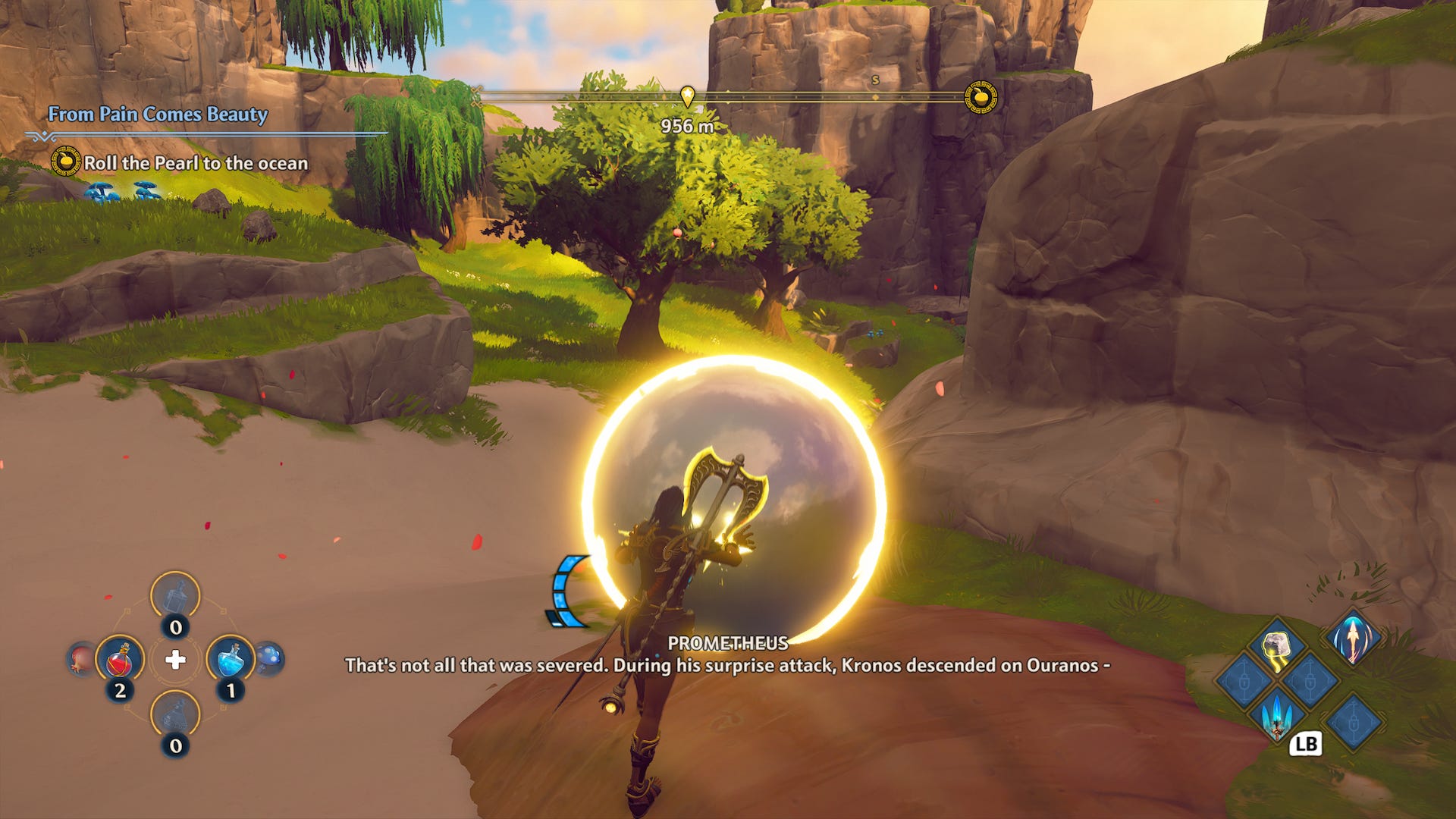
Not carry it. Roll it. The game gives you an actual physics puzzle: getting a pearl across a landscape to the water’s edge, working with and against the terrain, solving the geometry of the problem. And when you finally roll the pearl into the sea, Aphrodite is born from the foam.
This is mythologically precise. In Hesiod’s Theogony, Aphrodite rises from the sea foam formed around the severed genitals of Uranus, thrown into the ocean by his son Cronus — the “aphros,” the foam, giving her name. In later artistic traditions her water droplets transform into pearls as she emerges, and she is consistently depicted with shells and pearls as her symbols. The pearl — born in saltwater, built by a living creature in the same ocean — is the right object. Whoever wrote that quest knew something, or felt something, about what a pearl actually is.
In the entire database — 292 games, spanning 1987 to 2024 — Immortals Fenyx Rising is the only game where pearl functions as a purely cosmological object. No crafting value. No trade price. No stat bonus. It exists to enact a myth, in a medium that has spent forty years treating it as a colored token.
Why This Matters
Pearl is not a mineral. It’s a gemstone built from nacre — a composite of aragonite crystals and the organic protein conchiolin, secreted in alternating layers by the mollusk’s mantle. The inorganic and organic are inseparable in its structure; you cannot have one without the other. That composite nature is precisely what gives nacre its iridescence, and precisely what excludes pearl from the technical definition of a mineral, which requires an inorganic origin.
This matters because it makes pearl genuinely unlike anything else in the gem trade. Every other gemstone you can name formed without biological input: through igneous crystallization, metamorphic pressure, hydrothermal deposition. Even amber — also a gemstone, also organic — is fossilized tree resin, not the active secretion of a living animal. The pearl alone required a living creature to have a bad day, and to keep having it, layer by layer, for years. It is the only gemstone you can wear immediately upon finding it — no cutting, no polishing required. And while all gems have a formation history that geologists can interrogate, the pearl’s nacre layers record something different: not just when, but how — the temperature of the water that season, the chemistry of what the animal was eating, the isotopic signature of the environment it lived in. The layers aren’t annual rings like a tree; we can’t read them as a calendar. But they are a continuous environmental diary, written in aragonite, by an animal that had no idea it was writing.
None of this has made it into games in any meaningful way. The archive is unread. The animal is invisible. The history — the Gulf divers, the market collapse, the cultured pearl revolution, the endangered freshwater mussel in European rivers — has not crossed over.
But Aphrodite’s pearl, rolled across a video game hillside into a digital sea, gestured at something real. An object born in water, returned to water, becoming the occasion for a goddess’s arrival. It’s a strange place to find the oldest understanding of what a pearl actually is.
I went back to the drawer. I held one up to the light.
The iridescence shifted. Somewhere inside it, encoded in aragonite, is a record of water temperature from a year that no one alive remembers. A diary written by an animal that didn’t know it was writing.
I put it back carefully.
Data note: Pearl appears in 19 of 292 games in the Pocketful of Χtals games database (v3, March 2026). Of these, one game (Immortals Fenyx Rising, 2020) codes pearl as purely cosmological with no crafting, economic, or power-augmentation role. Eighteen assign pearl at least one instrumental function.
Quahog. GIA https://www.gia.edu/images/white-and-purple-pearl-636x358.jpg
Melo. instagram @conch.pearls https://www.instagram.com/p/C5pQxW1yOdK/
Conch. instagram @conch.pearls https://www.instagram.com/conch.pearls/p/DUQ065jk9uN/
Abalone. GIA https://www.instagram.com/p/DKceUeGvEOM/
CT Scan. Screenshot from GIA https://www.gia.edu/gems-gemology/summer-2010-pearls-microtomography-krzemnicki