
The Monster Problem
Why a goblin is a better source of rubies than the ground, and what that says about us

I’m maybe 20 hours into Diablo II when it happens. A fallen shaman explodes in a shower of gore and coins, and sitting in the wreckage, glowing red on the cave floor, is a ruby.
I pick it up without thinking. I slot it into my weapon like a battery — the game’s way of saying this gem now powers you. My fire damage increases. I move on.
It takes another twenty hours before the scientist in me finally wakes up and says: wait.
Where did that shaman get a ruby?
I mean this literally. The shaman was alive — animated, aggressive, casting spells at me. Before I killed it, it was a functioning creature moving through a cave. It had no pockets I could see. No mining equipment. No gemological supply chain. And yet, inside it, apparently, was a ruby. A corundum crystal formed under metamorphic pressure, somewhere between five and fifty kilometers underground, over a span of time measured in millions of years.
The shaman had been carrying it around.
I put down the controller and stared at the ceiling for a while. Then I went back to playing, because I needed more rubies.
This is the Monster Problem. Not that games do this — games abstract everything, and I’ll defend that shortly — but that we accept it so completely, so automatically, for minerals specifically, that it takes forty hours of active play before the question even surfaces. A ruby falls out of a goblin and it feels correct. That feeling is interesting. I want to understand it.
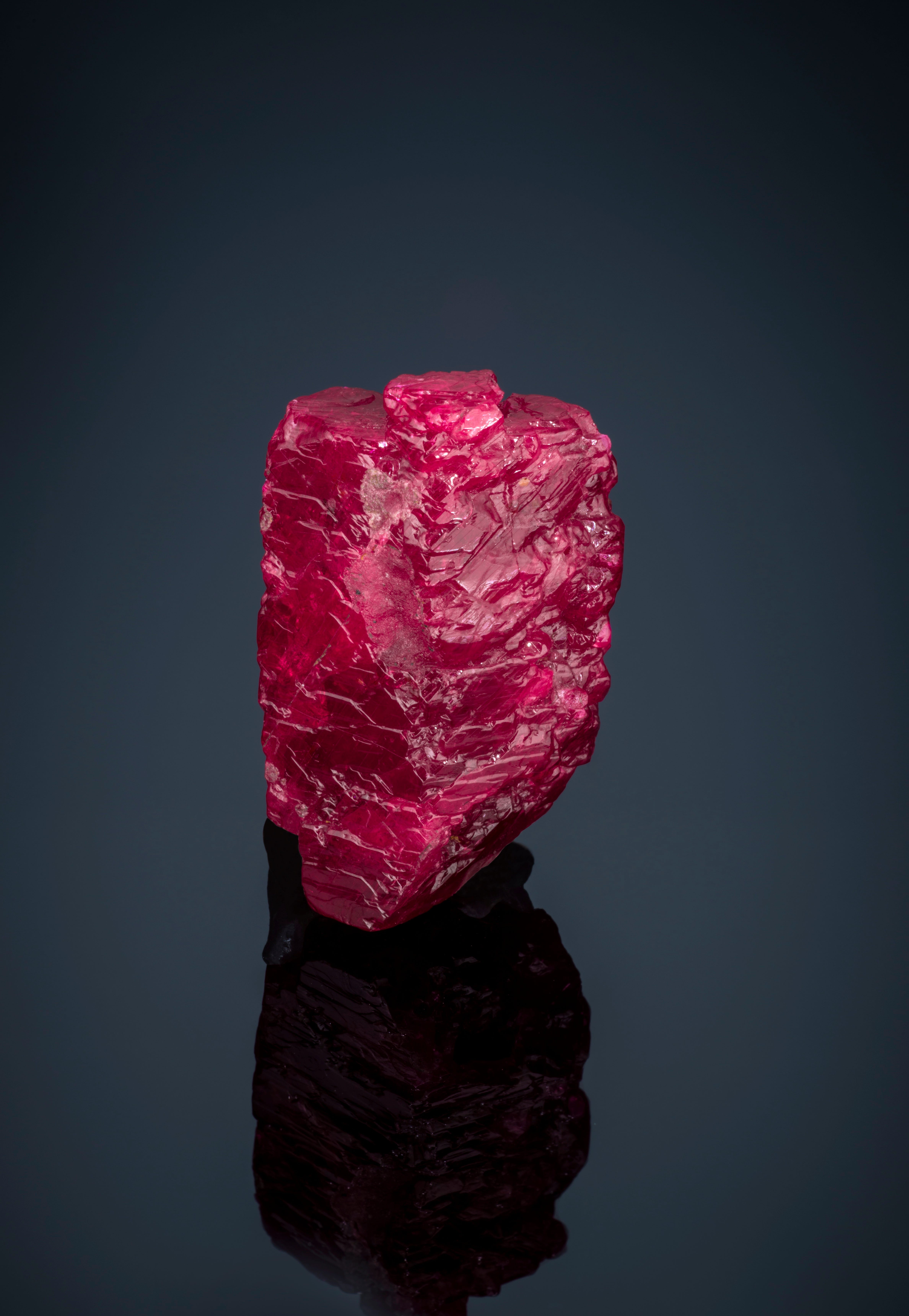
I work in a building full of rubies. As Curator of Mineral Sciences at the Natural History Museum of Los Angeles County, I spend my days explaining to visitors how gems actually form. A ruby is corundum — aluminum oxide — crystallized under the specific pressure and temperature conditions of regional metamorphism, its red color produced by chromium atoms substituting for aluminum in the crystal lattice. The whole process requires conditions that would kill anything living: depths measured in kilometers, temperatures above 500 degrees Celsius, timescales measured in tens of millions of years.
The formation history is the identity. That’s the thing I keep coming back to when I think about the shaman and his ruby. A ruby isn’t a red stone that happens to be hard and valuable. It’s a record — a physical inscription of specific pressure, chemistry, and time. You can read those conditions in the crystal structure. You can trace the tectonic history of the region in the inclusion patterns. The ruby is a document written by the earth over millions of years.
The shaman had been using it as a stat boost.
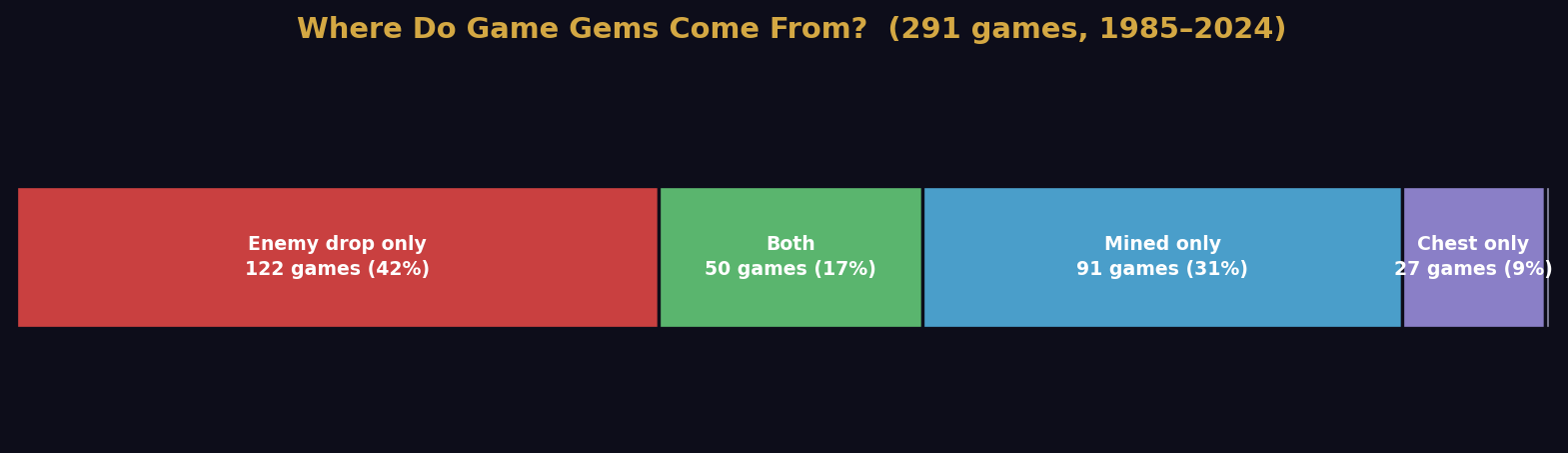
I have a database of 291 video games spanning four decades of game design. I built it to understand how games use minerals — what they include, what they ignore, and what their choices reveal about our collective relationship with the material world. And the first thing the data tells me is this: more games give you gems by killing enemies than by mining the ground.
172 games use enemy drops as a source of minerals. 141 use mining. And 122 games — 42% of all mineral-containing games in the database — give you gems exclusively from monsters, with no geological sourcing whatsoever. No mines. No ore veins. No geological context of any kind. The ruby comes from the shaman, full stop.
This has been normal game design for forty years. No one has asked why.
Before I ask why, I want to be fair about what this actually is. Games abstract constantly and gloriously. Your character carries fifty swords in an invisible backpack. You heal catastrophic injuries by eating a sandwich. You fall from a great height and walk it off. These aren’t failures of realism — they’re the necessary simplifications that make interactive entertainment work. The goblin carrying a ruby is in the same category as the inventory system that holds it. Game logic, not geological logic.
I’m not here to correct the goblin. I’m here to ask what it reveals that we never notice him.
The data has an answer, and it’s more interesting than “games are unrealistic.”
When I separate the 122 enemy-drop-only games from the 91 mined-only games and look at what minerals actually do in each group, a clear picture emerges. In games where gems come from enemies, their dominant function is power augmentation — they directly increase your combat statistics, boost your abilities, make you stronger. 59% of enemy-drop-only games use minerals this way.
In games where gems come from the ground, the dominant function is crafting and progression — you build things, upgrade equipment, advance economically. 70% of mined-only games use minerals this way. A further 58% use them as economic trade goods.
These aren’t just different game mechanics. They’re two different theories of what minerals fundamentally are.
When a gem comes from the earth, it’s a material — something extracted, processed, and transformed through labor and knowledge. The earth doesn’t yield a finished ruby; it yields corundum in a host rock, and understanding what that rock is, how it formed, and where to find it is the work. This is, more or less, how economic geology actually operates. A mining geologist reads the landscape for structural signatures, traces the metamorphic history of a region, and uses that knowledge to find what’s there. The games that model this well — and a handful do — quietly teach players to think like geologists without ever saying so.
When a gem comes from a monster, it’s concentrated power — something the creature held, something that passes to you when you defeat it. The monster was a vessel. The gem is the essence. You absorb it.
That second model is ancient. It precedes science by millennia. Every folk tradition that assigns healing, protective, or magical properties to minerals is operating on exactly this logic: power concentrates in objects, objects can transfer that power to their holder, and the holder’s virtue or strength determines how much power transfers. The healing crystal doesn’t care where it formed. The amulet doesn’t require a geological context to work. The power is in the object, independent of its origin.
The geological theory — where a mineral’s properties are caused by its formation conditions, where the ruby’s hardness comes from its crystal structure and its color from chromium substitution and both of those trace back to specific metamorphic conditions — is the scientific model. And in my database, it’s the minority position.
The clearest illustration of how this happened sits in five rows of my spreadsheet: Diablo (1996), Diablo II (2000), Diablo II: Resurrected (2021), Diablo III (2012), Diablo IV (2023). Five games, twenty-seven years. Every single one: gems from enemies, no mining, pure power augmentation. The Diablo franchise didn’t invent this design philosophy, but it codified it, refined it, and distributed it to hundreds of millions of players across three decades.
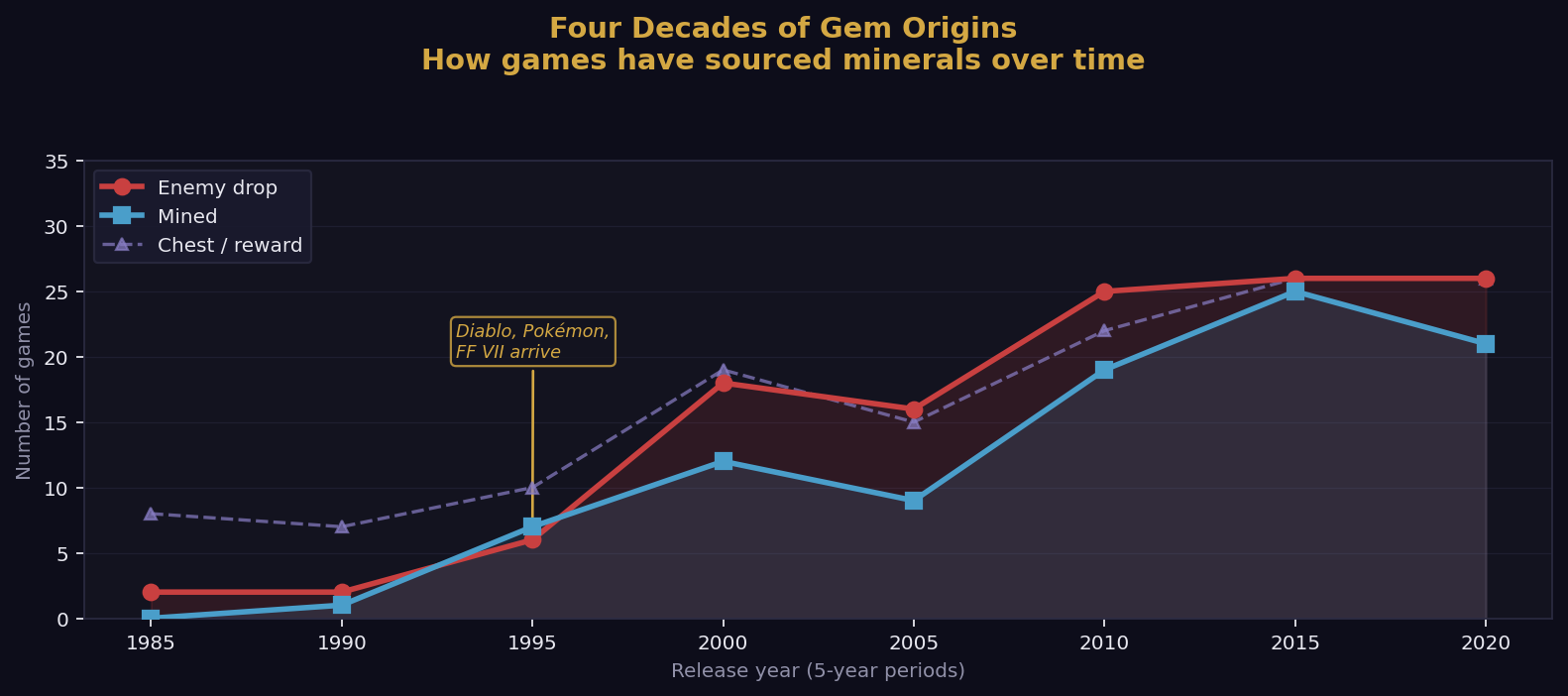
Compare that to Dragon Quest, which ran from 1986 to 1995 on a different model. In the original Dragon Quest games, gems don’t fall from enemies — they appear in treasure chests. That sounds like a small distinction. Mechanically, it barely matters. But semantically it’s enormous: a chest implies someone stored this. The gem had a prior life as a physical object that a person or entity put somewhere for a reason. It doesn’t live inside a creature. It exists in the world as a material thing.
Not every game made this trade. A small number of titles built their mineral systems around geological reality and are more compelling for it, not less. Vintage Story gives you cassiterite, galena, and sphalerite — real ore minerals with real names — and asks you to understand their properties to survive. Final Fantasy XIV includes twenty-three scientifically accurate mineral names, each tied to specific deposits in its world. Players of both games have written their own field guides. The knowledge stuck because the economy required it. These games are outliers in the database — but they’re the proof of concept that the formation story can be the economy, if someone chooses to build it that way.
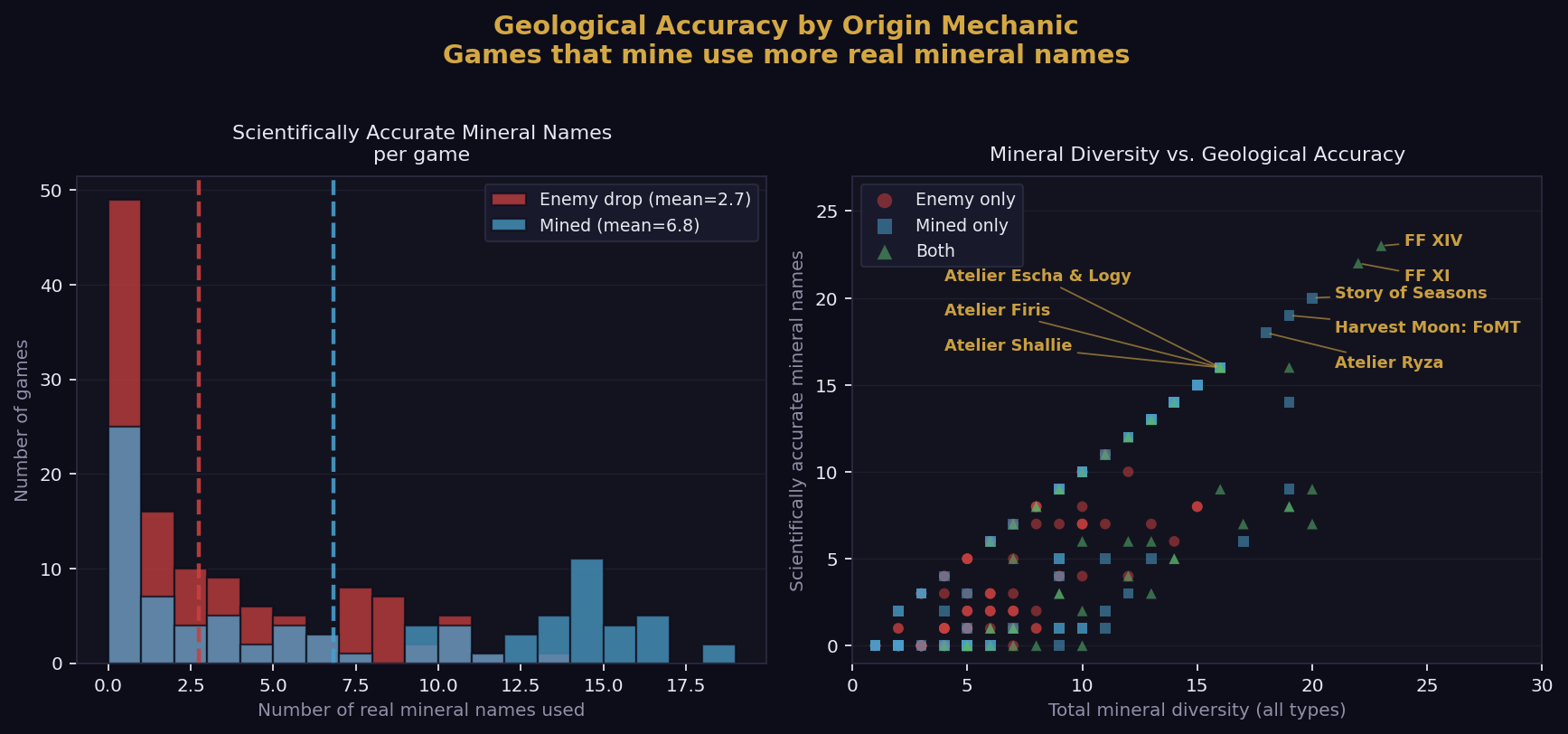
The Combat Augmentation cluster in my database — the group of games most purely organized around combat power mechanics — contains 63 games. Every single one drops gems from enemies. Eight of them bother to mine.
Here’s what I actually find fascinating about all of this, and why I don’t think the goblin is the problem.
The gem drop works — works completely, works addictively, keeps you playing for forty hours before you notice — because the game built the economy before it handed you the gem. By the time that ruby drops from the shaman, you already know exactly what rubies do, why you need them, what you’re going to socket them into, how many more you need. The origin is irrelevant because you’re already inside a system where the ruby’s function is established and consequential.
That’s the mechanism. Not variable reward psychology, not dopamine hits from loot drops — those are real but they’re downstream of something more fundamental. The gem means something because an economy was running before you got it. Strip the economy and the gem is confetti.
Now consider how science presents the same object. Here is corundum. Here is chromium substitution. Here is the Mohs scale. Here are the metamorphic conditions under which corundum forms. The facts arrive correct and complete. And they don’t stick, for most people, because there’s no economy running. There’s no system you’re inside where knowing about chromium substitution changes your situation. The knowledge is true and inert.
The goblin’s ruby isn’t invisible because players are scientifically illiterate. It’s invisible because the economy that makes the ruby matter was built first, and that economy had no need for a formation story.
What the shaman was carrying, underneath the game logic, was something genuinely ancient: the intuition that power concentrates in living things, that defeating something releases what it held, that gems are the currency of that transfer. That intuition is geologically wrong and culturally universal. It’s the same logic behind every healing crystal, every protective amulet, every gemstone prescribed in ancient medical texts — the ones I study in our collection, the ones that predate the science of mineralogy by four thousand years.
Games didn’t invent this. They inherited it. And because it’s so deeply intuitive — because it maps onto something real about how we understand living things to carry value — it never needed to be questioned.
The formation story got left out because the economy didn’t require it. Twenty-five million years of metamorphic pressure, chromium substituting atom by atom into an aluminum oxide lattice, kilometers of overburden pressing down while tectonic plates shifted overhead — none of that needed to be in the game for the ruby to function as a reward.
The job isn’t to fix the goblin. It’s to build an economy where the formation story is the thing you need to survive. Where knowing how a ruby forms changes your situation in the world you’re navigating.
That economy isn’t hypothetical. It has been running for five thousand years. The Bronze Age wasn’t named for a feeling — it was named for an alloy of copper and tin, two minerals that happen to co-occur in specific geological settings, and the civilizations that figured out where those settings were didn’t just make better weapons. They built the ancient world’s first global trade networks: copper from Cyprus, tin from Cornwall and Afghanistan, meeting in furnaces from Mesopotamia to the Aegean. The people who understood the geology had the power. Everyone else bought from them.


The economy is still running. The phone in your pocket contains lithium from brine deposits in the Atacama, cobalt from the Democratic Republic of Congo, rare earth elements refined almost entirely in China — each one the product of specific geological conditions that took hundreds of millions of years to create and that exist in only a handful of places on Earth. The countries that control those deposits are renegotiating the global order right now. Knowing where spodumene forms, and why, is not an academic exercise. It is geopolitics.
In the collection I curate, we have specimens from most of those deposits. Rocks pulled from the ground before anyone knew what they would eventually power. They look, to most visitors, like rocks. Interesting rocks, perhaps — some of them are beautiful — but rocks. The economy they’re embedded in is invisible because no one built the tutorial. No one set up the crafting system before handing them over.


Meanwhile, enrollment in geology and mineralogy programs has declined for two decades. The wellness industry — selling the same minerals, the same crystals, the same objects from the same deposits — is worth tens of billions of dollars annually and growing. The sacred register migrated. The stakes stayed exactly where they always were. We just stopped making people feel them.
That’s the job. Not to fix the goblin. To build the scientific economy where the formation story is the resource — because it already is one. We just haven’t made it feel like one yet.
And don’t blame the games. They figured out what people actually want long before we did. I’m still playing Diablo II. I still need more rubies. I just really want to know where that damn shaman got his.
The data in this post comes from the Pocketful of Χtals games database, v3 — 292 games across four decades of game design, coded for mineral content, origin mechanics, role functions, and design philosophy. The database is ongoing. If you think I’m missing a game, I probably am.
Was the Shaman first curator of the ruby’s hidden language? If geology was the seat of power, how do the scientist, the artist facilitate that 'power transfer' today? Great piece, Aaron.